Title here
Summary here
This project brings together Python tools to automate selected steps of ab initio molecular dynamics (AIMD) with VASP, using
AiiDA and the
aiida-vasp plugin. It was developed within DIAMOND to simplify calculation preparation, submission to computing facilities, and reproducible analysis of the results.
The current version provides two complementary modules: WF1, which extracts inherent structures from a liquid, and WF2, which estimates the equilibrium volume from fixed-volume simulations. A third module, WF3, is planned to combine these steps into a data-generation pipeline for machine-learning interatomic potentials (MLIPs).
VASP calculations are tracked by AiiDA, while some structural analyses use the free Python API of OVITO Basic. Parameters are organized in YAML files so that they can be adapted to a local computer or an HPC cluster.
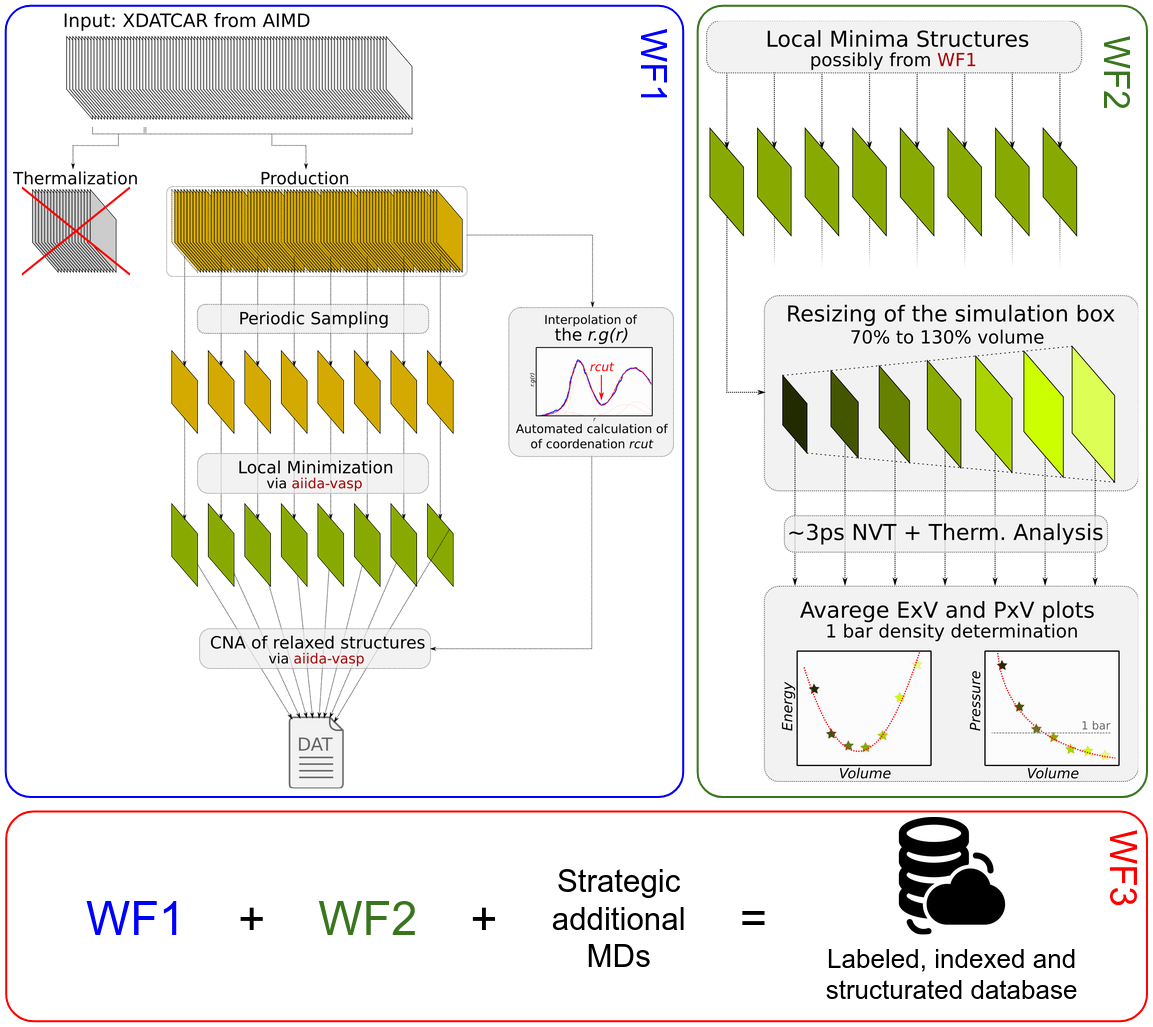
Overview of the available AiiDA-VASP workflows.
Input: a VASP trajectory in XDATCAR format.
WF1 selects configurations at regular intervals, optionally excluding the initial frames corresponding to thermalization. Each selected configuration is then submitted for fixed-cell atomic relaxation through AiiDA’s vasp.relax WorkChain. The relaxed structures represent local minima of the potential energy associated with the sampled configurations.
A post-processing step also makes it possible to:
Main outputs: relaxed structures in POSCAR format, an RDF table (rdf.csv), cutoff radii (pair_cutoffs.json), and CNA statistics (cna.csv). Automatically determined cutoffs should be checked before any scientific interpretation.
Input: one or more structures named POSCAR_<temperature> (with the temperature in kelvin, for example POSCAR_650).
For each temperature, WF2 generates several structures with different volumes, then submits NVT AIMD simulations using vasp.vasp. It calculates the average pressure over the final part of each trajectory by reading the OUTCAR files, then fits the pressure–volume relationship using the third-order Birch–Murnaghan equation of state.
The estimated equilibrium volume is the volume at which the fitted pressure becomes zero. This approach avoids systematically running a long NPT simulation when an initial estimate of the equilibrium volume is needed.
Main outputs: average pressures for each volume (pressures.csv), fitting parameters (eos_fits.json), and, if Matplotlib is installed, a pressure–volume plot (pressure_volume.png). The fit requires several appropriately chosen volumes and sufficiently equilibrated pressure data.
WF3 is under development and is not included in this version. The aim is to combine AIMD sampling, relaxation, equilibrium-volume determination, and calculations across different phases or thermodynamic conditions to produce datasets for materials characterization and, in particular, MLIP training.
Reusable code is located in src/diamond_aiida_vasp/, separately from the sample data and configuration files provided in examples/.
| Item | Contents |
|---|---|
examples/config/wf1.yml | Configuration selection, relaxation, and analysis parameters for WF1 |
examples/config/wf2.yml | Temperatures, volumes, and AIMD parameters for WF2 |
examples/cluster/ | Example YAML configurations for AiiDA computers and codes |
examples/data/wf1/ | Short example XDATCAR trajectory |
examples/data/wf2/ | Example POSCAR structures at different temperatures |
These examples are intended to introduce the interface and check the preparation steps: they do not, on their own, constitute a scientifically validated dataset. Calculation outputs are stored separately, generally in runs/ and results/.
To set up your environment and run a first example, see the Installation page.
The methodology is presented in Bissuel et al., Reproducible Container Solutions for Codes and Workflows in Materials Science (arXiv preprint: 2512.13826v1; published article, DOI:10.1002/adem.202503185).